SOCKET PROGRAMMING USING UDP
UDP
There are two major transport layer protocols to communicate between hosts TCP and UDP.
In UDP, the client does not form a connection with the server like in TCP and instead just sends a datagram. Similarly, the server need not accept a connection and just waits for datagrams to arrive. Datagrams upon arrival contain the address of sender which the server uses to send data to the correct client.
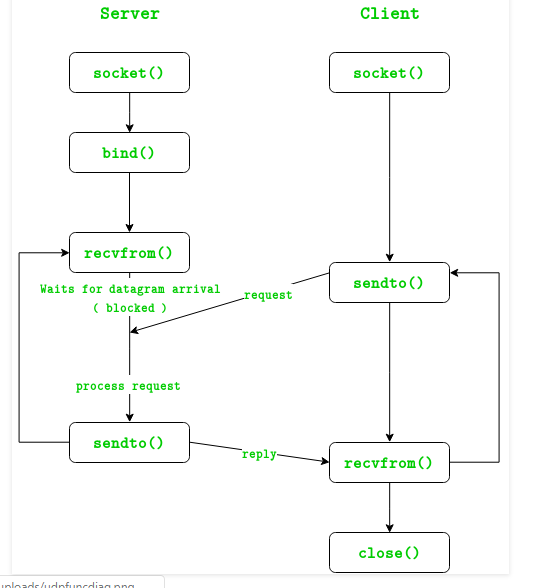
SERVER SIDE IMPLEMENTATION
// Implementation using DatagramSocket
import java.io.IOException;
import java.net.DatagramPacket;
import java.net.DatagramSocket;
import java.net.InetAddress;
import java.net.SocketException;
public class udpBaseServer_2
{
public static void main(String[] args) throws IOException
{
// Step 1 : Create a socket to listen at port 1234
DatagramSocket ds = new DatagramSocket(1234);
byte[] receive = new byte[65535];
    DatagramPacket DpReceive = null;
    while (true)
    {

        // Step 2 : create a DatgramPacket to receive the data.
        DpReceive = new DatagramPacket(receive, receive.length);

        // Step 3 : revieve the data in byte buffer.
        ds.receive(DpReceive);

        System.out.println("Client:-" + data(receive));

        // Exit the server if the client sends "bye"
        if (data(receive).toString().equals("bye"))
        {
            System.out.println("Client sent bye.....EXITING");
            break;
        }

        // Clear the buffer after every message.
        receive = new byte[65535];
    }
}

// A utility method to convert the byte array
// data into a string representation.
public static StringBuilder data(byte[] a)
{
    if (a == null)
        return null;
    StringBuilder ret = new StringBuilder();
    int i = 0;
    while (a[i] != 0)
    {
        ret.append((char) a[i]);
        i++;
    }
    return ret;
}
}
CLIENT SIDE IMPLEMENTATION
// Implementation using DatagramSocket
import java.io.IOException;
import java.net.DatagramPacket;
import java.net.DatagramSocket;
import java.net.InetAddress;
import java.util.Scanner;
public class udpBaseClient_2
{
public static void main(String args[]) throws IOException
{
Scanner sc = new Scanner(System.in);
    // Step 1:Create the socket object for
    // carrying the data.
    DatagramSocket ds = new DatagramSocket();

    InetAddress ip = InetAddress.getLocalHost();
    byte buf[] = null;

    // loop while user not enters "bye"
    while (true)
    {
        String inp = sc.nextLine();

        // convert the String input into the byte array.
        buf = inp.getBytes();

        // Step 2 : Create the datagramPacket for sending
        // the data.
        DatagramPacket DpSend =
            new DatagramPacket(buf, buf.length, ip, 1234);

        // Step 3 : invoke the send call to actually send
        // the data.
        ds.send(DpSend);

        // break the loop if user enters "bye"
        if (inp.equals("bye"))
            break;
    }
}
}
 Computer Networking